AI is fundamentally reshaping data center design, and nowhere is that more evident than in power infrastructure. Training and inference workloads driven by large-scale GPU clusters are pushing facilities beyond traditional limits. Rack densities that
once averaged 5–10 kW are now routinely exceeding 100–120 kW per rack, creating unprecedented strain on electrical systems.
At the same time, next-generation AI environments demand higher-voltage architectures, tighter integration between power and cooling, and significantly greater resiliency. Power is no longer a supporting system; it is a primary constraint on growth.
Why Traditional Electrical Infrastructure Slows Deployment
Conventional electrical infrastructure was never designed for the speed and scale required by AI data centers. Legacy approaches rely on fragmented workflows, involving multiple contractors, extended onsite construction, and complex system integration.
Traditional onsite assembly increases the risk of integration errors, as systems are validated only after installation.
These legacy constraints create several bottlenecks:
- Lengthy deployment timelines
- Increased risk of integration errors
- Supply chain variability across components
- Limited ability to scale quickly
In an AI-driven environment where speed-to-capacity is critical, these inefficiencies can delay revenue generation and reduce competitive advantage.
In contrast, modern modular approaches such as Modular Electrical Buildings (MEBs) enable factory-based, system-level validation before deployment, significantly reducing integration risk and accelerating time to readiness.
What Are Power Skids, E-Houses and Modular Electrical Buildings?
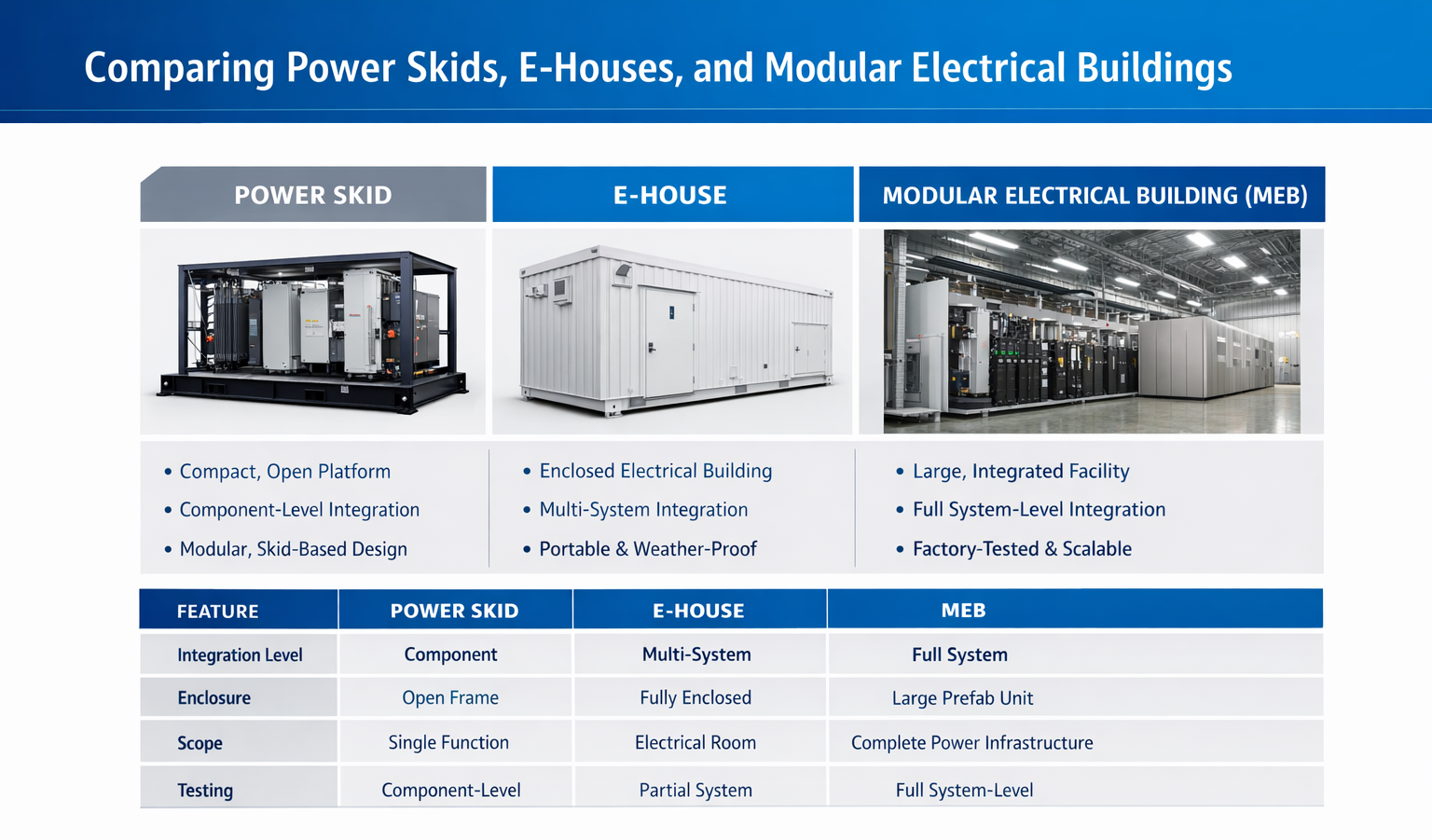
Power skids, E-houses and Modular Electrical Buildings (MEBs) are all prefabricated electrical infrastructure solutions, but they operate at different levels of integration and scale. Understanding how they relate is key to designing for speed, reliability,
and scalability in AI data centers.
Power Skids (Component-Level Integration)
Power skids are compact, skid-mounted systems that integrate specific electrical subsystems such as transformers, UPS units, and/or switchgear into a single, transportable platform. They are typically deployed as building blocks within a larger power
architecture, reducing onsite assembly and simplifying installation at the subsystem level.
E-Houses (Enclosed System Integration)
E-houses (electrical houses) take integration a step further by housing multiple electrical components within a protective enclosure. These prefabricated structures provide environmental protection and pre-integrated electrical distribution, enabling
faster deployment and improved reliability compared to traditional onsite builds.
Modular Electrical Buildings (Full System-Level Integration)
MEBs represent the most complete, productized approach. These fully integrated, factory-built environments combine power distribution, protection systems, thermal management, and monitoring into a single, scalable unit. Critically, MEBs are engineered,
assembled, and factory-tested at the system level before shipment, significantly reducing onsite risk and commissioning time.
 From Construction to Productized Infrastructure
Across all three approaches, the shift is the same: moving from fragmented, onsite construction to standardized, factory-integrated solutions.
These systems typically incorporate:
- Transformers
- UPS systems
- Switchgear
- HVAC and cooling elements
By enabling factory-based assembly and validation, organizations can:
- Accelerate deployment timelines
- Reduce integration risk
- Improve quality and consistency
- Scale infrastructure in a repeatable, modular way
This evolution transforms electrical infrastructure from a custom construction project into a repeatable, design-led product platform, purpose-built for the demands of AI and next-generation data centers.
How Modular Electrical Buildings Accelerate Data Center Deployment
An MEB takes the power module concept further by serving as a larger, prefabricated enclosure that houses and integrates multiple power modules into a unified system. MEBs combine these modular subsystems, such as power distribution, protection, and thermal
management, into a single, scalable environment that is engineered and factory-tested at the system level before deployment.
The benefits are significant:
- Faster deployment: Parallel manufacturing and site preparation reduce timelines
- Reduced complexity: Factory integration minimizes onsite coordination
- Scalability: Infrastructure can expand incrementally with demand
- Consistency: Standardized builds improve reliability and performance
By shifting complexity offsite and into controlled manufacturing environments, MEBs enable data center operators to deploy power infrastructure at the pace AI demands.
Celestica Provides Modular Power Infrastructure
As a strategic partner for AI-scale and mission-critical deployments, Celestica brings a design-led, innovation-focused approach to modular power infrastructure, addressing one of the most critical constraints in the digital economy: scalable, reliable
power.
Rather than treating infrastructure as a series of disconnected components, Celestica delivers fully integrated, end-to-end solutions that unify every layer of the stack, from grid interface to rack-level distribution, and from initial design through
lifecycle operations. This includes modular data center solutions that integrate advanced power and cooling with industry-leading IT infrastructure, including racks, storage, switching, and networking platforms.
Our approach is built on:
- End-to-end turnkey delivery: From system architecture and application-aware design through manufacturing, integration, and deployment, Celestica delivers fully integrated modular electrical systems that reduce complexity and accelerate time-to-market.
- Mission-critical experience: Proven expertise in delivering high-availability infrastructure for hyperscalers and OEMs ensures performance, resilience, and operational continuity at scale.
- Application-aware infrastructure design: Purpose-built for AI and high-density workloads, aligning power delivery with advanced cooling and compute requirements.
- Seamless system integration: Tight integration of racks, power, and cooling systems into a cohesive, factory-validated architecture, minimizing onsite risk and accelerating deployment.
- Global manufacturing scale: Regionally aligned, high-volume Tier 1 production capabilities that enable rapid, consistent rollout across geographies.
- Supply chain and execution leadership: Deep procurement expertise and vertically integrated execution mitigate risk across critical components while ensuring predictable delivery.
- End-to-end lifecycle services: Comprehensive aftermarket support spanning installation, commissioning, and ongoing maintenance, ensuring infrastructure is deployed efficiently, performs as designed, and remains optimized over time.
By combining integrated solution engineering, system-level architecture, and global execution, Celestica de-risks system complexity and capital deployment while compressing time-to-market.
This approach bridges the gap between legacy infrastructure and next-generation AI environments, enabling customers to deploy mission-critical power infrastructure at unprecedented speed and scale in an increasingly energy-constrained world.
Power Infrastructure for the Next Generation of AI Data Centers
The next phase of AI infrastructure will be defined by how intelligently it can be deployed and adapted over time.
This is where modular, system-level approaches create lasting advantage, enabling organizations to respond to shifting workloads, evolving technologies, and increasing density without re-architecting from the ground up. For decision-makers, the focus
is shifting from building capacity to building flexibility into the foundation of their infrastructure.
Celestica supports this transition by engineering power environments designed to evolve with what comes next. To learn how Celestica accelerates
AI data center deployment with modular electrical infrastructure, schedule a meeting with one of our experts.